Choosing between a PPE factory in China and a trading company isn’t about which one is universally “better.” It’s about which one aligns with your business stage, risk tolerance, and sourcing goals. Make the wrong call, and you could end up paying more than necessary, dealing with inconsistent quality, or—worse—facing compliance issues that put users at risk.
This guide breaks it down clearly so you can make the right decision for your PPE sourcing strategy.
Why Choosing Between PPE Factory China and Trading Company Matters for Buyers
Personal Protective Equipment (PPE) is not just another product category—it’s safety-critical. Whether you’re sourcing masks, gloves, or protective clothing, you’re dealing with products that must meet strict regulatory standards such as CE, FDA, or ISO.
That means your supplier choice directly affects:
- ●Product safety and compliance
- ● Cost structure and margins
- ● Supply chain stability
- ● Brand reputation
In short, the supplier model you choose has long-term consequences for your business.
What Is a PPE Factory China and How It Works for Bulk Orders
A PPE factory (manufacturer) is the actual producer of the goods. They handle:
- ● Raw material sourcing
- ● Production and assembly
- ● Quality control processes
- ● Certification and testing
For bulk orders, factories typically operate with:
- ● Higher Minimum Order Quantities (MOQs)
- ● Lower per-unit pricing
- ● Direct communication with production teams
This makes them ideal for businesses that need consistency, scalability, and control.
What Is a PPE Trading Company in China and Its Advantages for Buyers
A trading company acts as an intermediary between buyers and multiple factories. Instead of producing goods, they:
- ● Source products from different manufacturers
- ● Consolidate orders across categories
- ● Handle export logistics and documentation
Their key advantages include:
- ● Lower or more flexible MOQs
- ● Access to a wide range of PPE products
- ● Easier communication and faster response times
- ● Reduced operational complexity
They’re especially useful for buyers who want convenience or are new to sourcing in China.
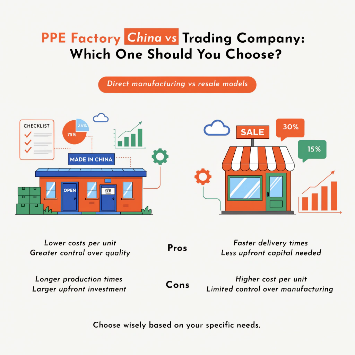
PPE Factory China vs Trading Company: Key Differences in Price, MOQ, and Flexibility
Here’s a straightforward comparison:
Factor | PPE Factory (Manufacturer) | Trading Company |
Price | Lower (no middleman) | Higher (5–30% markup) |
MOQ | Higher | Lower / flexible |
Flexibility | Lower | Higher |
Product Range | Specialized | Broad (multi-category) |
Communication | Sometimes complex | Usually smoother |
Speed | Slower setup | Faster execution |
Factories win on cost and control. Trading companies win on flexibility and convenience.
How to Compare Quality Control Between PPE Manufacturer China and Trading Companies
Quality control is where the difference becomes critical.
With a PPE factory:
- ● You get direct oversight of production
- ● Easier to conduct factory audits
- ● Certifications are more traceable
- ● Consistency is easier to maintain
With a trading company:
- ● QC depends on the underlying factory
- ● Less visibility into production processes
- ● Risk of inconsistent suppliers over time
For PPE, where compliance is non-negotiable, direct manufacturer control is often the safer option.
Which Option Offers Better OEM and Customization with PPE Supplier China
If you’re building a brand or need product differentiation, customization matters.
Factories offer:
- ● Full OEM/ODM capabilities
- ● Material and design adjustments
- ● Custom molds and branding
- ● Faster implementation of changes
Trading companies:
- ● Relay requests to factories
- ● Slower iteration cycles
- ● Limited technical influence
If customization is a priority, working directly with a factory is the more effective route.
How Lead Time and Supply Chain Differ Between PPE Factory China and Trading Company
Lead time and logistics can vary significantly.
Factories:
- ● Longer initial setup
- ● More stable production timelines
- ● Fewer intermediaries once established
Trading companies:
- ● Faster initial sourcing
- ● Can switch suppliers quickly
- ● May introduce variability in lead times
If speed is critical at the start, trading companies have an edge. For long-term stability, factories are more reliable.
What Risks Should You Consider When Choosing PPE Supplier China
Both models come with risks—you just need to understand them.
TradiQuestionable or borrowed certifications
- ● Limited production transparency
Factory risks:
- ● Communication gaps leading to specification errors
- ● High MOQs increasing financial exposure
- ● Some lack export or documentation experience
For PPE, the biggest mistake is assuming compliance without verifying it. Always validate certifications and production capability.
Conclusion: How to Choose Between PPE Factory China and Trading Company for Your Business
The decision ultimately comes down to your current business needs.
Choose a PPE factory if:
- ● You require certified, compliant PPE
- ● You are ordering at scale
- ● You need customization or private labeling
- ● You want long-term cost efficiency and stability
Choose a trading company if:
- ● You’re testing products or markets
- ● You need smaller order quantities
- ● You want to source multiple PPE categories
- ● You prefer a simpler, faster sourcing process
Final Insight: The Smart Strategy Most Buyers Use
In reality, many experienced importers don’t stick to just one model.
A common approach is:
- ● Start with a trading company for speed and flexibility
- ● Transition to a factory as volume grows
This hybrid strategy allows you to reduce risk early while optimizing cost and control over time.
Post time: Apr-20-2026